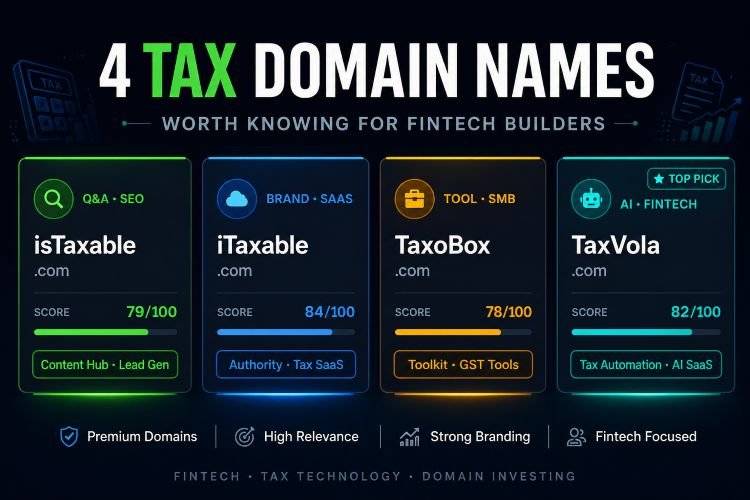
Every day, millions of people search variations of a simple question: “Is this taxable?” Whether it’s freelance income, crypto gains, gifts, or side hustles, the need for clear, trustworthy tax answers continues to grow. That’s exactly where a domain like isTaxable.com stands out. It captures real user intent in its purest form – question-based search – making it a powerful foundation for an SEO-driven content platform. In this post, we break down the strengths, limitations, and monetization potential of this domain, and how it can be developed into a scalable, high-traffic asset in the finance space.
Here’s the rewritten evaluation of isTaxable.com without any icons:
Vertical Scoring Table
| Metric | Value |
|---|---|
| Domain | isTaxable.com |
| Type | Exact-match Q/A |
| Structure | Hybrid (Question-led) |
| Chars | 10 |
| Words | 2 |
| Brandability | 7 / 10 |
| Commercial Intent | 9 / 10 |
| Demand / Comps | 8 / 10 |
| Risk | 0 |
| Final Score | 79 / 100 |
| Verdict | Keep / Build |
Here’s a long-form rewritten article based on your structure, refined into a cohesive, publication-ready piece:
Building a High-Intent Tax Platform with isTaxable.com
At its core, isTaxable.com is built around one of the most powerful drivers of online behavior: direct questions. Every day, users search variations of “Is this taxable?”—from freelance income and crypto gains to gifts and side hustles. This makes the domain uniquely positioned to capture high-intent traffic and convert it into multiple revenue streams.
What follows is a breakdown of how this domain can be developed into a scalable digital asset, combining content strategy, programmatic SEO, and monetization systems.
Primary Use Cases
Authority Blog / SEO Content Hub
The most natural starting point is building an authority-driven content hub. This involves publishing high-quality, in-depth articles that answer common and complex tax-related questions.
Content can be organized into topical clusters such as income types, investments, and special tax scenarios. For example, entire sections can be dedicated to freelance income, cryptocurrency taxation, or gift-related rules. Each article should go beyond surface-level answers by including examples, edge cases, and jurisdiction-specific insights.
Over time, this approach builds topical authority in search engines, allowing the site to rank for competitive keywords. Since tax-related searches are evergreen and spike seasonally, this model creates a compounding traffic engine that grows stronger each year.
Tax Q&A Knowledge Base
While long-form content builds authority, a structured Q&A knowledge base captures precision traffic. This involves creating concise, standardized pages that directly answer specific questions.
Each page can follow a repeatable format: a clear yes/no answer, a brief explanation, exceptions, and location-specific variations. For instance, a page answering “Is gift money taxable in India?” would differ slightly from its US counterpart, allowing for geographic segmentation.
This format aligns perfectly with how users search and how search engines display results, especially in featured snippets and “People Also Ask” sections. It also enables the site to scale efficiently across hundreds or thousands of queries.
Lead Generation Platform for Tax Professionals
Traffic alone has limited value unless it is converted. One of the most effective ways to monetize is by turning visitors into leads for tax professionals.
Users who land on the site are often looking for clarity, and many will require personalized advice. By integrating clear calls-to-action—such as “Talk to a Tax Expert” or “Get Your Tax Situation Reviewed”—the platform can capture high-intent leads.
These leads can then be routed to accountants or tax consultants based on geography and complexity. Revenue can be generated through pay-per-lead models, revenue sharing, or subscription access for professionals. Given the high value of tax clients, even a modest conversion rate can yield significant returns.
Programmatic SEO at Scale
The real growth multiplier lies in programmatic SEO. This involves systematically generating pages targeting variations of the core query: “Is X taxable?”
By building a structured database of income types, financial activities, and jurisdictional rules, the site can automatically create thousands of pages. Examples include queries related to gig economy income, digital assets, or emerging financial trends.
However, scale must be balanced with quality. Each page should provide meaningful value through examples, clarifications, and localized insights. When executed properly, this strategy enables rapid expansion into long-tail search queries with relatively low competition.
Monetization Models
Ad Networks
Display advertising provides a foundational revenue layer. Tax and finance-related keywords are among the highest-paying in digital advertising, making even informational traffic valuable.
By placing ads strategically within content—especially on high-traffic informational pages—the site can generate consistent passive income. Optimization can further improve returns by targeting audiences in higher-value regions and refining ad placements.
Affiliate Partnerships
Affiliate marketing offers a more direct revenue channel, particularly through partnerships with tax software and financial tools.
As users seek help in calculating or filing taxes, the site can recommend relevant platforms within its content. This can include contextual mentions, comparison articles, and seasonal guides aligned with tax deadlines.
Because the recommendations align closely with user intent, conversion rates tend to be strong, especially during peak filing periods.
Lead Generation
Lead generation represents one of the highest-value monetization strategies. Instead of relying on passive clicks, the site actively connects users with professionals who can solve their problems.
By capturing detailed information—such as income type, location, and complexity—the platform can qualify leads before passing them on. This increases their value and allows for premium pricing.
Over time, this can evolve into a marketplace model where tax professionals compete for access to high-quality leads.
Digital Products
Finally, the platform can develop its own digital products to monetize its audience directly. These may include tax guides, checklists, templates, or even structured courses.
For example, a freelancer-focused tax guide or a cryptocurrency tax toolkit could address specific user segments. These products can be created by repurposing existing content and packaging it into actionable formats.
This approach not only generates high-margin revenue but also strengthens the brand’s authority and trust.
Strategic Positioning
The strength of isTaxable.com lies in its ability to align perfectly with user intent. It captures users at the moment they are asking a question, then guides them through a journey—from information to action.
At the top of the funnel, SEO content attracts traffic. In the middle, structured knowledge and tools deepen engagement. At the bottom, monetization channels such as leads, affiliates, and products convert that attention into revenue.
When executed cohesively, this creates a self-reinforcing system where content drives growth, and growth fuels further expansion.
Final Takeaway
isTaxable.com is not just a domain—it is a framework for building a high-intent, scalable digital business in the finance space. Its success depends less on the name itself and more on the execution behind it.
With the right combination of structured content, programmatic scale, and monetization strategy, it has the potential to evolve into a durable, revenue-generating asset that compounds over time.
Interested in Owning
If you are building a product or service in the Fintech space, TaxoBox.com can serve as a strong and practical brand. Reach out through the Contact page to explore acquisition opportunities.
Domain Appraisal: By Atom.com