Choosing a domain name is no longer just about finding something “available.” A strong and perfect domain name should support your brand, make sense to your audience, and be flexible enough to grow with your venture.
Table of Contents
AI tools can help you generate ideas faster, explore angles you may not think of on your own, and save time. But human judgment is still what turns a random name into a meaningful brand asset.
Here is a step-by-step process that combines both.
Step 1: Start With Your Venture Clarity
Before using any AI tool or domain generator, get clear on what your venture actually is.
Write down answers to these questions:
- What problem does your venture solve?
- Who is it for?
- What transformation or result do you offer?
- Is your brand serious, modern, premium, playful, local, or global?
- Do you want the name to be descriptive, brandable, or a mix of both?
For example:
- A descriptive name explains what you do directly
- A brandable name sounds unique and memorable
- A hybrid name gives both clarity and identity
This step matters because AI works best when your inputs are sharp.
Step 2: Create a Core Keyword Bank
Now, list words related to your business.
Include:
- Industry words
- Audience words
- Benefit words
- Emotion words
- Action words
- Style words
Example: Considering a freelance educator business: teach, learn, mentor, online, course, trainer, freelance, educator, grow, earn, guide, academy
Do not judge the words yet. Just build a raw list. This keyword bank becomes the fuel for both AI and your own brainstorming.
Step 3: Define Your Naming Direction
Now decide what kind of domain name you want.
Possible directions:
- Exact and descriptive:
TryToEarn.com - Benefit-focused:
SkillMonetizer.com - Brandable:
Teachora.com - Authority-based:
FreelanceEducator.com - Community-style:
TeacherGrowthHub.com - Personal brand aligned:
RohitGuides.com
This prevents AI from giving you names that sound clever but do not align with your actual business direction.
Step 4: Use AI for Wide Idea Generation
Now bring in AI.
Ask AI tools to generate domain name ideas based on:
- Your business type
- Audience
- Tone
- Keyword bank
- Naming style
A useful prompt could be:
“Generate 50 domain name ideas for a business that helps non-technical professionals start freelancing and build online income. Keep the names clear, memorable, brandable, and suitable for a .com domain. Mix descriptive, authority-based, and brandable styles.”
Then try variations like:
- “Generate short premium-sounding domain names.”
- “Generate names that sound trustworthy and beginner-friendly.”
- “Generate names for a global audience.”
- “Generate names that could work as a blog and service brand.”
At this stage, quantity matters more than perfection.
Step 5: Use Human Creativity to Improve AI Suggestions
AI often gives decent starting points, but many names need refinement. Now review the AI list and improve it manually.
You can:
- Combine two partial ideas
- Shorten long names
- Replace weak words
- Remove awkward spelling
- Remove hyphens and numbers unless strategically useful
- Test alternate word order
- Turn phrases into stronger brand forms
Example:
AI gives:
- StartFreelanceToday.com
- FreelanceGrowthSteps.com
- DigitalIncomeBeginner.com
You may refine into:
- CityFreelancer.com
- AboutFreelancing.com
- TryToEarn.com
This is where human taste becomes more important than AI output.
Step 6: Filter Out Weak Names Early
Before checking domain name availability, remove bad options. Reject names that are:
- Hard to spell
- Too long
- Too generic
- Rasily confused with other brands
- Too narrow if you may expand later
- Awkward when spoken aloud
- Dependent on trends that may fade
- Difficult to pronounce
- Visually messy when written
A good domain should pass the “say it, spell it, remember it” test.
If someone hears it once, they should have a fair chance of typing it correctly.
Step 7: Check Meaning, Tone, and Brand Fit
Ask yourself:
- Does this sound trustworthy?
- Does it match my audience?
- Does it sound like a real business?
- Can I imagine this on a logo, email, website, and social profile?
- Will this still work if my business grows?
For example, a fun, quirky name may work for a creative project, but not for a consulting brand where trust matters more.
AI can suggest names. Humans must judge fit.
Step 8: Create a Shortlist
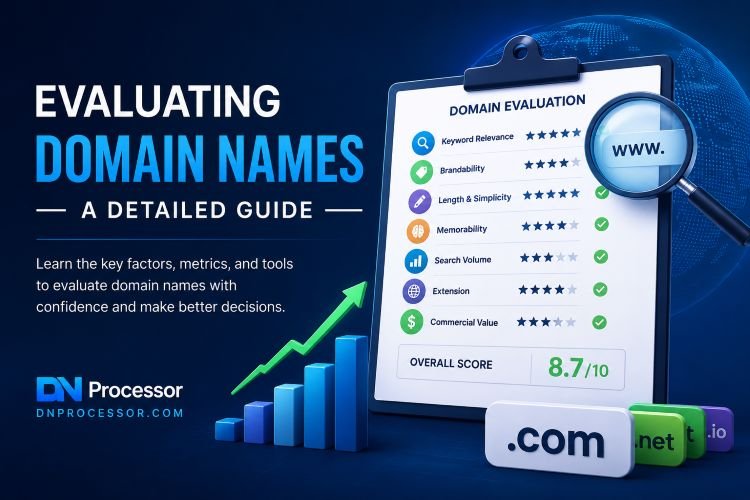
Now narrow everything down to around 10 to 15 strong options. For each shortlisted name, score it on:
- Clarity
- Memorability
- Spelling ease
- Brandability
- Future scalability
- Emotional appeal
- Audience fit
You can use a simple rating from 1 to 5 for each factor. The goal is not just to pick what sounds nice. It is to pick what works strategically.
Step 9: Check Domain Availability
Now check whether the domain name is available.
Focus first on:
- TLD > .com
- Country extension if relevant, such as .in
- Alternate extensions only if they truly suit the brand
When checking availability, also watch for:
- Premium pricing
- Previously registered versions
- Odd spelling conflicts
- Very similar existing businesses
Sometimes the best name is not the most creative one. It is the one that is available, clean, and commercially usable.
Step 10: Check Social Handle Availability
A good domain name should also work across platforms. Look for username availability on platforms like:
- X
- YouTube
You do not always need exact matches everywhere, but your brand should be reasonably consistent. This step is often ignored, but it helps avoid future branding confusion.
Step 11: Do a Basic Brand Conflict Check
Before finalizing, check for possible conflicts.
Look for:
- Existing companies with similar names
- Active websites in the same niche
- Trademark concerns in your region or industry
- Names that may confuse customers
You do not want to invest time in a name and later realize it is too close to another established brand.
This is a business safety step, not just a naming step.
Step 12: Test the Name With Real Humans
Now ask a few trusted people:
- What do you think this business does from the name?
- Is it easy to say and remember?
- Which one sounds most trustworthy?
- Which one sounds premium?
- Which one would you click on?
Do not ask too many people. Too much feedback creates noise.
Choose a few people who understand your audience or business direction.
Human reaction matters because your audience is human, not AI.
Step 13: Let It Sit for a Day
A name can sound exciting in the moment and weak the next day.
Revisit your shortlist after some time and ask:
- Do I still like it?
- Does it still feel aligned?
- Is it flexible enough?
- Am I choosing it because it is available, or because it is right?
This pause helps reduce emotional over-attachment to a name that may not actually be the best.
Step 14: Finalize and Secure It Fast
Once you are confident:
- Register the domain name
- Secure relevant extensions if useful
- Reserve social handles
- Create a professional email address
- Note down brand usage rules
Good names disappear fast. Once you decide, act.
Step 15: Build Meaning Around the Name
A domain name becomes powerful when you give it context.
After choosing it, define:
- Your brand tagline
- Your positioning statement
- What the name stands for
- How will you explain it to your audience
Even a simple name becomes stronger when it is supported by a clear story and consistent branding.
How AI Helps in the Process
AI is useful for:
- Idea generation at scale
- Exploring combinations quickly
- Testing tones and styles
- Creating keyword banks
- Suggesting alternatives
- Refining raw concepts
- Generating brand directions for different audiences
But AI alone is not enough.
AI does not fully understand:
- Your long-term business vision
- Emotional fit
- Cultural nuance
- Real-world trust signals
- Legal risks
- Your instinct about brand potential
That is why the best results come from AI plus human judgment.
A Simple Formula to Remember
Use this formula:
Business clarity + keyword thinking + AI ideation + human refinement + availability checks = stronger domain name choices
Final Thought
The perfect domain name is rarely found by accident. It is usually developed through a thoughtful process. AI can speed up exploration. Human creativity gives the name meaning, direction, and business value. So do not just ask, “Is this domain name available?”
Ask:
- Does it fit my audience?
- Does it support my future?
- Does it sound like something worth building?
That is how better domain names are chosen. If you have any questions or concerns, you can contact the author. or even reach our team.