Over the years, as someone deeply involved in buying, evaluating domain names, and flipping them, I’ve realized one thing:
A good domain name is not just a name. It’s a business opportunity waiting to be discovered.
Whenever I register or evaluate a domain—whether it’s something like KeywordBucket.com, LoanAssociate.com, or even a newer idea like TaxVola.com—I follow a structured thought process that has been refined through countless evaluations, wins, and yes, some expensive lessons.
In this comprehensive post, I’m going to walk you through exactly how I think when I evaluate a domain name. This isn’t theory from a textbook—this is real-world experience distilled into a framework you can use immediately.
Table of Contents
- The Foundation: Evaluating Domain Names
- My Strategic Thinking: Brand vs Keyword
- Advanced Checks I Personally Do
- Red Flags I Never Ignore
- My Personal Scoring Method
- What I’ve Learned Over Time
- Final Thought
The Foundation: Evaluating Domain Names
1. Length — The First Filter I Apply
The moment I see a domain, my brain automatically evaluates its length. It’s almost subconscious now.
From years of experience in this space, I’ve learned one fundamental truth:
Short equals valuable. Long equals risky unless very meaningful.
Think about it from a business perspective. When someone hears your domain name once, can they remember it? Can they type it without looking it up? Length directly impacts both these factors.
For example:
- A name like
TaxVola.comworks beautifully because it’s short, punchy, and brandable. It rolls off the tongue. - Something long and complex like
AffordableTaxConsultingServices.com? I usually avoid it unless it’s a strong exact-match keyword with proven search demand.
My personal sweet spot:
- 6–12 characters for brandable domains
- Under 15 characters overall for any domain I’m serious about
Anything beyond that needs very strong justification. I need to see either massive search volume, perfect keyword matching, or an established business already looking for that exact name.
Here’s why length matters so much in practice: When I’m pitching a domain to a potential buyer, the conversation goes much smoother with KeywordBucket.com than with something unwieldy. Shorter names stick in people’s minds. They’re easier to put on business cards, marketing materials, and promotional content.
Every additional character you add reduces memorability exponentially. It’s not linear—it’s exponential. A 20-character domain isn’t just twice as hard to remember as a 10-character one; it’s potentially five to ten times harder.
2. Extension — The Reality Check
I’ll be honest here, and this might sound harsh to some:
If it’s not a .com, I become more critical instantly.
This isn’t snobbery—it’s market reality. After watching domain sales, buyer behavior, and resale patterns for years, the data is clear.
From what I’ve seen in the market:
- .com is still dominant and commands premium pricing
- .net and .org work in specific cases (tech companies sometimes use .net, nonprofits gravitate to .org)
- Other extensions depend heavily on use case and are generally speculative
Let me give you a concrete example from my own portfolio:
LoanAssociate.com is strong because of the .com extension plus the clear business application. The combination of a finance keyword with the trusted .com makes it attractive to loan advisors, fintech startups, and financial consultancies.
If the exact same name was LoanAssociate.net or LoanAssociate.io? I would probably skip it entirely or value it at 10-20% of the .com price.
My rule of thumb:
If it’s not .com, the domain must compensate with exceptional branding or extraordinary keyword power. It needs to be so good in other areas that buyers overlook the extension.
The few exceptions I’ve seen work:
- .io domains for developer tools and tech startups (GitHub.io established this pattern)
- .ai domains specifically for artificial intelligence companies (the category match matters)
- Country codes when targeting that specific market (.co.uk for UK businesses, .de for German markets)
But even these exceptions prove the rule: the extension must make sense for the specific buyer. You’re narrowing your market when you go non-.com, so everything else needs to be perfect.
3. Pronounceability — The “Radio Test”
One trick I always use, and I recommend you do the same:
If I say this domain out loud on the radio, will someone type it correctly on their first try?
This simple test has saved me from many bad investments.
Domains like KeywordBucket.com pass this test effortlessly. Say it out loud: “Keyword Bucket dot com.” Clear. Easy. No ambiguity. Someone hearing that once could type it correctly.
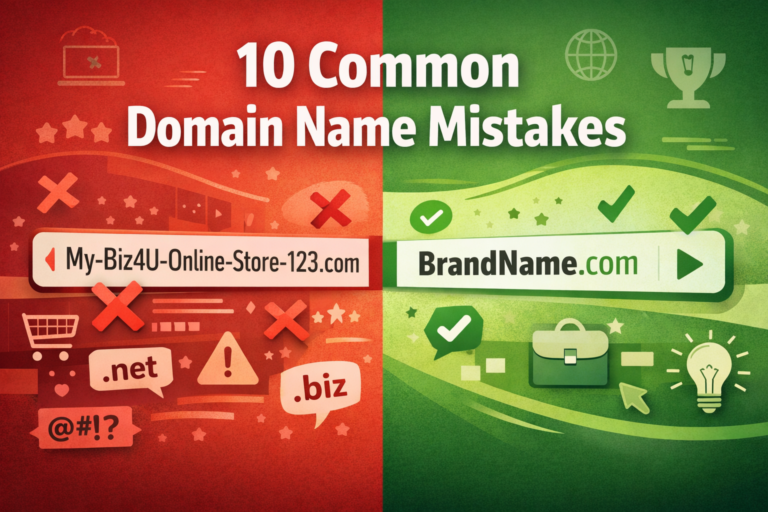
Now imagine trying to convey Kwik-Shop4U.com over the phone. You’d need to spell it out: “That’s K-W-I-K, hyphen, Shop, the number 4, the letter U, dot com.” You’ve already lost them.
Red flags I personally avoid:
- Hyphens (they kill brandability and confuse users)
- Numbers (is it “4” or “four”?) create ambiguity
- Confusing spellings (unless you’re building the brand yourself with millions in marketing)
- Homophones (their/there, to/too/two)
Why do I avoid these? Because resale becomes exponentially harder.
When I’m selling a domain, I want the buyer to “get it” immediately. I don’t want to be explaining spelling or defending the choice of a hyphen. The domain should sell itself.
TaxVola.com passes the radio test perfectly. “Tax Vola” is pronounceable, memorable, and unambiguous. There’s no confusion about spelling once you hear it.
My Strategic Thinking: Brand vs Keyword
Every single domain I evaluate falls into one of two strategic buckets, and understanding which bucket your domain fits into changes everything about how you value it and who you market it to.
1. Keyword / Exact-Match Domains
Example from my portfolio: LoanAssociate.com
This domain clearly signals several things instantly:
- Industry: Finance, lending, credit
- Role: Advisor, consultant, intermediary
- Function: Association, connection, partnership
These domains sell because they match search intent and capture existing demand.
When someone Googles “loan associate” or related terms, they’re looking for exactly what this domain represents. The domain name itself is the search query.
What makes keyword domains valuable:
- Search volume: People are actively searching for this term
- Commercial intent: Searchers are ready to do business
- SEO advantage: Exact-match domains still carry weight in search rankings
- Instant credibility: The domain tells visitors exactly what you do
With LoanAssociate.com, the buyer pool is clear: loan advisors, mortgage brokers, fintech companies building loan platforms, financial consultancies, lead generation companies in the lending space.
I don’t need to explain the vision or pitch the brand story. The value is self-evident to anyone in that industry.
My evaluation process for keyword domains:
- Check search volume (Google Keyword Planner, Ahrefs, SEMrush)
- Look at cost-per-click in Google Ads (high CPC = high commercial value)
- Identify who’s bidding on these keywords (competitors = potential buyers)
- Assess if it’s a growing or declining trend
- Calculate potential traffic value
If the keyword has strong metrics across these factors, I know I have something with concrete, measurable value.
2. Brandable Domains
Example from my portfolio: TaxVola.com
This is fundamentally different from a keyword domain.
TaxVola.com isn’t just capturing a keyword—it’s a brand story waiting to happen.
“Vola” could suggest:
- Volatility (for tax planning around market changes)
- Voila (the satisfaction of easy tax filing)
- A sleek, modern, tech-forward feeling
It’s memorable, unique, and creates curiosity. When someone hears “TaxVola,” they think “What’s that?”—and that curiosity is valuable.
When I see brandable names, I ask different questions:
- Can a startup build a product around this?
- Does it sound like a company that could raise venture capital?
- Is it memorable enough to stick after one mention?
- Does it evoke the right feeling for its industry?
- Can it scale beyond its initial category?
Brandable domains are harder to value because you’re not selling traffic or search rankings—you’re selling potential and positioning.
But when they work, they work spectacularly well.
Think about brands like:
- Stripe (payment processing)
- Asana (project management)
- Notion (productivity)
None of these are keyword matches. They’re pure brand plays. And they’ve built billion-dollar companies on these names.
TaxVola.com has that same brandable quality. It’s short, distinctive, professional yet modern, and perfect for a tax SaaS platform, automation tool, or financial planning service.
The buyer for this domain isn’t looking for SEO juice—they’re looking for a name that can become a recognized brand in the tax and finance space.
Advanced Checks I Personally Do While Evaluating Domain Names
1. Who Will Buy This? (The Most Critical Question)
This question separates domain investors who make money from those who don’t.
Before I buy or keep any domain, I force myself to answer clearly and specifically:
Who is the buyer?
Not “businesses” or “startups”—that’s too vague. I need specific buyer profiles.
For example:
LoanAssociate.com — My buyer list:
- Independent loan advisors looking to establish credibility
- Mortgage brokerage firms expanding online
- Fintech startups building loan comparison platforms
- Lead generation companies in the lending vertical
- Financial consultancies adding loan services
KeywordBucket.com — My buyer list:
- SEO agencies need a memorable brand
- Keyword research tool developers
- Digital marketing SaaS companies
- Content marketing platforms
- PPC management software providers
TaxVola.com — My buyer list:
- Tax software startups
- Accounting automation companies
- Financial planning platforms
- Tax consulting firms are modernizing their brand
- Blockchain/crypto tax tools
If I can’t create this specific list, I don’t invest. Period.
Why this matters:
When you know your buyer, you know:
- Where to list the domain
- How to price it
- What language to use in your sales pitch
- Which features to emphasize
- How long to hold it
Vague buyer profiles lead to domains sitting unsold for years.
2. Commercial Intent (My Background in Media Buying Shows Here)
Coming from a media buying and RSOC (Return on Spend on Content) background, I look at domains through a monetization lens that most domain investors overlook.
I ask:
- Does this keyword have CPC value? (What are advertisers paying per click?)
- Can it attract organic search traffic?
- Can it be monetized via ads, leads, or affiliate commissions?
- What’s the lifetime value of a customer in this niche?
This thinking completely changes how I value domains.
Example:
Finance domains like LoanAssociate.com typically have:
- High CPC ($15-$50+ per click in competitive markets)
- Strong conversion rates (people searching are ready to act)
- High customer lifetime value (a single loan generates significant revenue)
- Multiple monetization paths (lead gen, partnerships, direct services)
Compare that to a hobby or entertainment domain with:
- Low CPC ($0.10-$1.00 per click)
- Lower conversion intent
- Limited monetization options
The commercial intent lens helps me avoid weak investments.
A domain might be short, .com, and brandable, but if it’s in a low-value niche with no clear monetization path, I pass.
Conversely, a slightly longer domain in a high-CPC vertical might be worth more than a shorter domain in a worthless niche.
KeywordBucket.com is perfect here because:
- SEO and keywords are a billion-dollar industry
- High CPC for keyword research tools ($20-$50+)
- Clear B2B SaaS monetization path
- Recurring revenue potential (subscription tools)
This commercial analysis has helped me avoid countless domains that looked good on paper but had no real business potential.
3. Risk Check (Legal Due Diligence)
I’ve learned this lesson the hard way, and I’m sharing it to save you the pain:
One legal issue can completely destroy domain value.
I’ve seen domain investors lose thousands because they didn’t check trademarks before buying.
My risk assessment checklist:
Trademark Conflicts:
- USPTO database search (for US trademarks)
- WIPO database (for international marks)
- Google search for existing businesses with similar names
- Industry-specific trademark databases
What I’m looking for:
- Exact matches in the same industry = automatic pass
- Similar names in related industries = proceed with extreme caution
- Generic terms = usually safe, but verify
- Descriptive phrases = typically okay
Example scenarios:
If I’m looking at a domain like AppleTax.com – instant red flag. Apple is one of the most litigated trademarks in the world. Even in an unrelated industry, the risk is too high.
But LoanAssociate.com? “Loan” is generic, “Associate” is generic, and combined, they describe a service category, not a specific trademarked brand. That’s a green light.
TaxVola.com? “Tax” is generic, and “Vola” isn’t a known trademark in the financial space (at the time of evaluation). Clean.
Other risk factors I check:
- Brand confusion: Does it sound too similar to a major brand?
- Industry overlap: Even if not trademarked, could it cause confusion?
- Previous use: Was this domain used for something questionable before?
If there’s any significant risk, I walk away.
The potential upside is never worth the legal headache and potential financial loss.
Red Flags I Never Ignore – Evaluating Domain Names
From my experience evaluating hundreds of domains, these factors reduce domain value significantly or kill it entirely:
1. Hyphens
Hyphens are almost always a death sentence for domain value.
Why?
- They’re forgotten when people type the domain
- They look spammy and unprofessional
- They split your traffic (people will type it without the hyphen)
- Major brands avoid them completely
The only exception: Very specific, exact-match local business searches where the hyphen separates geo from service (plumber-denver.com). And even then, value is minimal.
For any domain I’m seriously considering, hyphens are an instant disqualifier.
2. Numbers
Numbers create ambiguity:
- Is it “4” or “four”?
- Is it “2” or “to” or “two”?
Every time someone has to ask, you’ve lost value.
Rare exceptions:
- Established web terms (Web 2.0, G2B, B2C)
- Tech version numbers where it’s industry standard
- Very short premium numbers (1.com, 360.com)
For 99% of domains, numbers reduce value by 50-80%.
3. Very Long Names
Anything over 15-18 characters needs exceptional justification.
Long names:
- Are harder to remember
- Take longer to type
- Don’t fit well in marketing materials
- Look unprofessional in email addresses
4. Confusing Spelling
Alternative spellings that seem clever often backfire:
- “Kwik” instead of “Quick”
- “Lite” instead of “Light”
- Creative misspellings
Unless you have millions for brand building (like Flickr or Tumblr did), avoid this entirely.
5. No Clear Use Case
If you can’t immediately articulate who would buy the domain and why, it’s probably not valuable.
“Someone might want this someday” is not a strategy—it’s hope.
6. Trademark Issues
As discussed above, any trademark conflict makes the domain worthless or worse (a liability).
My Personal Scoring Method – Evaluating Domain Names
Whenever I seriously evaluate a domain, I mentally score it across six dimensions:
Scoring Framework
1. Extension Quality (0-10 points)
- 10: .com
- 5: .net
- 3: .org or premium country code for that market
- 1-2: New gTLDs (.tech, .io, etc.)
- 0: .biz, .info, or obscure extensions
2. Length (0-10 points)
- 10: Under 8 characters
- 8: 8-12 characters
- 6: 13-15 characters
- 3: 16-18 characters
- 1: 19+ characters
3. Clarity (0-10 points)
- 10: Instantly clear meaning and use case
- 7: Clear with a moment of thought
- 4: Somewhat ambiguous
- 1: Confusing or unclear
4. Brandability (0-10 points)
- 10: Highly memorable, unique, perfect for branding
- 7: Good brand potential
- 4: Generic but functional
- 1: Unmemorable or awkward
5. Commercial Intent (0-10 points)
- 10: High CPC, strong search volume, clear monetization
- 7: Good commercial potential
- 4: Some commercial application
- 1: Hobby or low-value niche
6. Buyer Fit (0-10 points)
- 10: Can name 5+ specific buyer types immediately
- 7: 2-3 clear buyer categories
- 4: 1 potential buyer type
- 1: No clear buyer
Domain Score Examples
| Criteria | LoanAssociate.com | KeywordBucket.com | TaxVola.com |
|---|---|---|---|
| Extension | 10 (.com) | 10 (.com) | 10 (.com) |
| Length | 8 (13 chars) | 8 (14 chars) | 9 (8 chars) |
| Clarity | 10 | 9 | 7 |
| Brandability | 7 | 8 | 10 |
| Commercial Intent | 10 | 9 | 9 |
| Buyer Fit | 10 | 9 | 8 |
| TOTAL | 55/60 | 53/60 | 53/60 |
| Rating | Premium | Premium | Premium |
Interpretation scale:
- 50-60 points: Premium domain, hold for high-value sale
- 35-49 points: Good domain, marketable, fair value
- 20-34 points: Marginal domain, only keep if personal use
- Below 20: Likely not worth renewal fee
If it scores well across most dimensions, I either hold it for the right buyer or actively market it.
What I’ve Learned Over Time About Evaluating Domain Names
After working with many domains over the years, here are my hard-earned takeaways:
1. Quality Beats Quantity
I would rather hold 10 strong domains than 100 average ones.
Why?
- 10 premium domains require less renewal cost
- They’re easier to market
- Each one has real sales potential
- Less time wasted managing junk
Early in my domain career, I made the mistake of bulk registration—dozens of domains that “might” be valuable.
Most weren’t. Most expired without a single inquiry.
Now I’m ruthlessly selective. Every domain I register needs to pass my evaluation framework. No exceptions.
2. Clarity Sells
Domains like LoanAssociate.com sell faster because the use case is obvious.
When a potential buyer lands on your sales page or sees your domain listing, you have seconds to capture their interest.
Clear, obvious domains communicate their value instantly:
- The buyer immediately understands the application
- No explanation needed
- They can envision their business using it
- The value proposition is self-evident
Ambiguous domains require explanation, education, and vision-selling. That’s a much harder sale.
3. Brandables Need Storytelling
Domains like TaxVola.com sell when you explain the vision.
Unlike keyword domains, brandable domains require you to paint a picture.
In my sales copy for TaxVola.com, I might write:
“Imagine a tax software platform that makes filing feel like magic—Voilà! Your taxes are done. TaxVola combines the authority of ‘Tax’ with the modern, sleek sound of a venture-backed SaaS company. It’s the perfect name for the Stripe of tax software.”
See the difference? I’m selling the vision, the brand story, the potential.
With keyword domains, the data sells itself. With brandables, storytelling sells.
4. Patience Is Important
Good domains can take time to sell, but the right buyer makes it worthwhile.
I’ve had domains sell within days of listing.
I’ve had other premium domains take 18 months to find the right buyer.
The key is: if you’ve done your evaluation properly and you know the domain is solid, don’t panic sell.
The right buyer is out there. They might be:
- Building their startup right now
- Getting funded next quarter
- Rebranding their existing business
- Finally getting budget approved
Premium domains are not liquid assets—they’re long-term holdings that sell when the right opportunity aligns.
My rule: If a domain scores 50+ in my framework, I’m comfortable holding it for 2-3 years to find the right buyer at the right price.
5. Coming from Media Buying Changes Everything
My background in media buying and RSOC has given me a unique lens on domain valuation.
I don’t just see a name—I see:
- Traffic potential
- Monetization pathways
- Customer acquisition cost
- Lifetime value calculations
- ROI potential for a buyer
This analytical framework helps me identify undervalued domains that other investors miss.
When I see KeywordBucket.com, I’m not just thinking “oh, it’s about keywords.”
I’m thinking:
- SEO tool market size ($billions)
- Subscription pricing models ($50-$500/month)
- Customer LTV (24+ month retention)
- Acquisition cost via this domain (lower with exact match)
- Competitive landscape (who needs this?)
This deeper analysis leads to better buying decisions and stronger sales pitches.
Final Thought – About Evaluating Domain Names
At the end of the day, after all the analysis, scoring, and strategic thinking, it comes down to one fundamental truth:
A domain is only valuable if someone sees a business opportunity in it.
That’s how I evaluate every domain I own.
If I can clearly articulate:
- Who will buy it (specific buyer profiles, not vague categories)
- Why they need it (what problem it solves or opportunity it creates)
- How they will use it (concrete application, not abstract potential)
Then I know I’m holding something worth keeping, marketing, and eventually selling at a fair price.
If I can’t answer those three questions clearly and specifically, the domain doesn’t belong in my portfolio—no matter how clever the name seems.
The domains I’ve shared today—KeywordBucket.com, LoanAssociate.com, and TaxVola.com—each passed this rigorous evaluation.
They score highly across my framework. They have clear buyers. They solve real business problems. They’re worth holding until the right opportunity comes along.
If you’re building your own domain portfolio, start thinking like this.
Don’t register domains on impulse or because they “sound cool.” Apply a framework. Ask hard questions. Be ruthlessly honest about value.
The domain investing game rewards patience, analysis, and strategic thinking—not hope and speculation.
Evaluate like an investor. Think like a buyer. Sell like a marketer.
That’s the formula that’s worked for me across hundreds of domain evaluations, and it’s the same formula I use every single time I consider adding a new domain to my portfolio.
If you wish to discuss with me your thoughts, then do ping me on LinkedIn, or connect with Team DNP