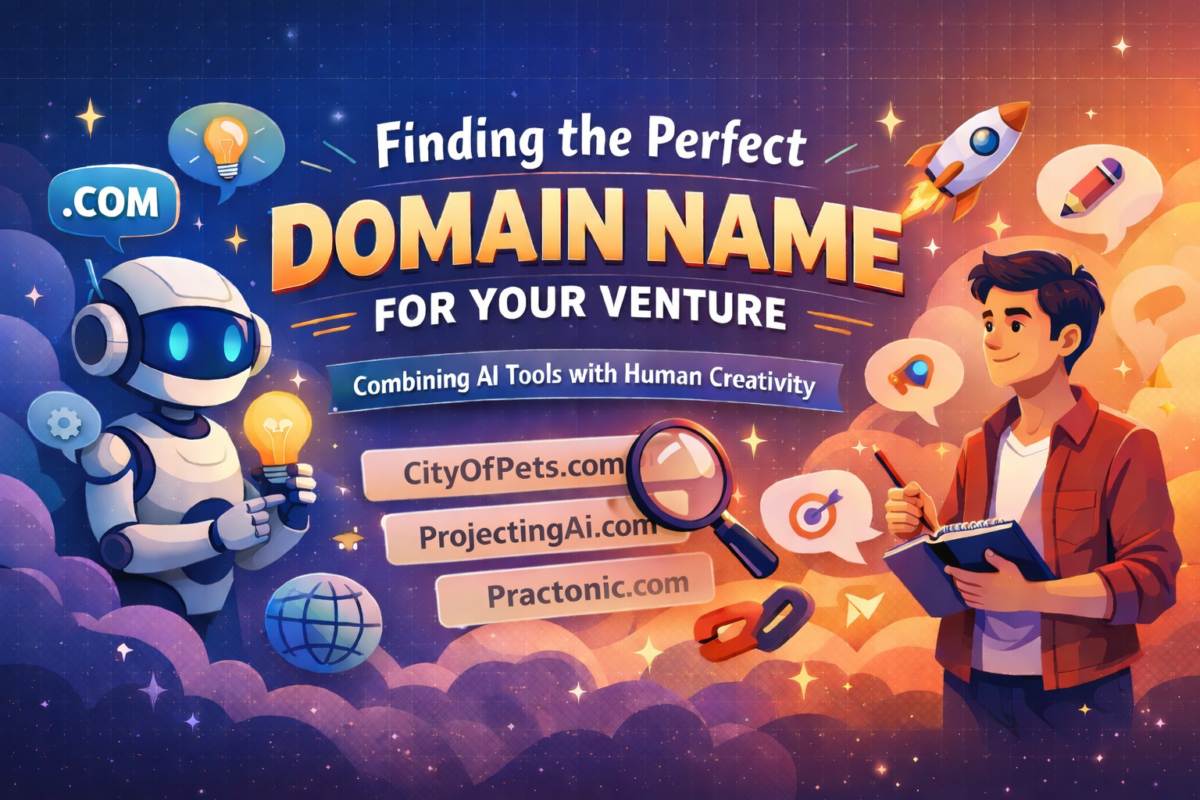
How to Find the Perfect Domain Name for Your Venture in 2026

Combining AI Tools With Human Creativity

Choosing a domain name is no longer just about finding something “available.” A strong domain name should support your brand, make sense to your audience, and be flexible enough to grow with your venture.

AI tools can help you generate ideas faster, explore angles you may not think of on your own, and save time. But human judgment is still what turns a random name into a meaningful brand asset.

Here is a step-by-step process that combines both.

Step 1: Start With Your Venture Clarity

Before using any AI tool or domain generator, get clear on what your venture actually is.

Write down answers to these questions:

  • What problem does your venture solve?
  • Who is it for?
  • What transformation or result do you offer?
  • Is your brand serious, modern, premium, playful, local, or global?
  • Do you want the name to be descriptive, brandable, or a mix of both?

For example:

  • A descriptive name explains what you do directly
  • A brandable name sounds unique and memorable
  • A hybrid name gives both clarity and identity

This step matters because AI works best when your inputs are sharp.

Step 2: Create a Core Keyword Bank

Now, list words related to your business.

Include:

  • Industry words
  • Audience words
  • Benefit words
  • Emotion words
  • Action words
  • Style words

Example: Considering a freelance educator business: teach, learn, mentor, online, course, trainer, freelance, educator, grow, earn, guide, academy

Do not judge the words yet. Just build a raw list. This keyword bank becomes the fuel for both AI and your own brainstorming.

Step 3: Define Your Naming Direction

Now decide what kind of domain name you want.

Possible directions:

  • Exact and descriptive: TryToEarn.com
  • Benefit-focused: SkillMonetizer.com
  • Brandable: Teachora.com
  • Authority-based: FreelanceEducator.com
  • Community-style: TeacherGrowthHub.com
  • Personal brand aligned: RohitGuides.com

This prevents AI from giving you names that sound clever but do not fit your real business direction.

Step 4: Use AI for Wide Idea Generation

Now bring in AI.

Ask AI tools to generate domain name ideas based on:

  • Your business type
  • Audience
  • Tone
  • Keyword bank
  • Naming style

A useful prompt could be:

“Generate 50 domain name ideas for a business that helps non-technical professionals start freelancing and build online income. Keep the names clear, memorable, brandable, and suitable for a .com domain. Mix descriptive, authority-based, and brandable styles.”

Then try variations like:

  • “Generate short premium-sounding domain names.”
  • “Generate names that sound trustworthy and beginner-friendly.”
  • “Generate names for a global audience.”
  • “Generate names that could work as a blog and service brand.”

At this stage, quantity matters more than perfection.

Step 5: Use Human Creativity to Improve AI Suggestions

AI often gives decent starting points, but many names need refinement. Now review the AI list and improve it manually.

You can:

  • Combine two partial ideas
  • Shorten long names
  • Replace weak words
  • Remove awkward spelling
  • Remove hyphens and numbers unless strategically useful
  • Test alternate word order
  • Turn phrases into stronger brand forms

Example:

AI gives:

  • StartFreelanceToday.com
  • FreelanceGrowthSteps.com
  • DigitalIncomeBeginner.com

You may refine into:

  • CityFreelancer.com
  • AboutFreelancing.com
  • TryToEarn.com

This is where human taste becomes more important than AI output.

Step 6: Filter Out Weak Names Early

Before checking domain name availability, remove bad options. Reject names that are:

  • Hard to spell
  • Too long
  • Too generic
  • Rasily confused with other brands
  • Too narrow if you may expand later
  • Awkward when spoken aloud
  • Dependent on trends that may fade
  • Difficult to pronounce
  • Visually messy when written

A good domain should pass the “say it, spell it, remember it” test.

If someone hears it once, they should have a fair chance of typing it correctly.

Step 7: Check Meaning, Tone, and Brand Fit

Ask yourself:

  • Does this sound trustworthy?
  • Does it match my audience?
  • Does it sound like a real business?
  • Can I imagine this on a logo, email, website, and social profile?
  • Will this still work if my business grows?

For example, a fun, quirky name may work for a creative project, but not for a consulting brand where trust matters more.

AI can suggest names. Humans must judge fit.

Step 8: Create a Shortlist

Now narrow everything down to around 10 to 15 strong options. For each shortlisted name, score it on:

  • Clarity
  • Memorability
  • Spelling ease
  • Brandability
  • Future scalability
  • Emotional appeal
  • Audience fit

You can use a simple rating from 1 to 5 for each factor. The goal is not just to pick what sounds nice. It is to pick what works strategically.

Step 9: Check Domain Availability

Now check whether the domain name is available.

Focus first on:

  • TLD > .com
  • Country extension if relevant, such as .in
  • Alternate extensions only if they truly suit the brand

When checking availability, also watch for:

  • Premium pricing
  • Previously registered versions
  • Odd spelling conflicts
  • Very similar existing businesses

Sometimes the best name is not the most creative one. It is the one that is available, clean, and commercially usable.

Step 10: Check Social Handle Availability

A good domain name should also work across platforms. Look for username availability on platforms like:

  • LinkedIn
  • Instagram
  • X
  • YouTube
  • Facebook

You do not always need exact matches everywhere, but your brand should be reasonably consistent. This step is often ignored, but it helps avoid future branding confusion.

Step 11: Do a Basic Brand Conflict Check

Before finalizing, check for possible conflicts.

Look for:

  • Existing companies with similar names
  • Active websites in the same niche
  • Trademark concerns in your region or industry
  • Names that may confuse customers

You do not want to invest time in a name and later realize it is too close to another established brand.

This is a business safety step, not just a naming step.

Step 12: Test the Name With Real Humans

Now ask a few trusted people:

  • What do you think this business does from the name?
  • Is it easy to say and remember?
  • Which one sounds most trustworthy?
  • Which one sounds premium?
  • Which one would you click on?

Do not ask too many people. Too much feedback creates noise.

Choose a few people who understand your audience or business direction.

Human reaction matters because your audience is human, not AI.

Step 13: Let It Sit for a Day

A name can sound exciting in the moment and weak the next day.

Revisit your shortlist after some time and ask:

  • Do I still like it?
  • Does it still feel aligned?
  • Is it flexible enough?
  • Am I choosing it because it is available, or because it is right?

This pause helps reduce emotional over-attachment to a name that may not actually be the best.

Step 14: Finalize and Secure It Fast

Once you are confident:

  • Register the domain name
  • Secure relevant extensions if useful
  • Reserve social handles
  • Create a professional email address
  • Note down brand usage rules

Good names disappear fast. Once you decide, act.

Step 15: Build Meaning Around the Name

A domain name becomes powerful when you give it context.

After choosing it, define:

  • Your brand tagline
  • Your positioning statement
  • What the name stands for
  • How will you explain it to your audience

Even a simple name becomes stronger when it is supported by a clear story and consistent branding.

How AI Helps in the Process

AI is useful for:

  • Idea generation at scale
  • Exploring combinations quickly
  • Testing tones and styles
  • Creating keyword banks
  • Suggesting alternatives
  • Refining raw concepts
  • Generating brand directions for different audiences

But AI alone is not enough.

AI does not fully understand:

  • Your long-term business vision
  • Emotional fit
  • Cultural nuance
  • Real-world trust signals
  • Legal risks
  • Your instinct about brand potential

That is why the best results come from AI plus human judgment.

A Simple Formula to Remember

Use this formula:

Business clarity + keyword thinking + AI ideation + human refinement + availability checks = stronger domain name choices

Final Thought

The perfect domain name is rarely found by accident. It is usually developed through a thoughtful process. AI can speed up exploration. Human creativity gives the name meaning, direction, and business value. So do not just ask, “Is this domain name available?”

Ask:

  • Does it fit my audience?
  • Does it support my future?
  • Does it sound like something worth building?

That is how better domain names are chosen. If you have any questions or doubts, you can connect with the author.

Prevent Domain Hijacking in 2026: Save Your Brand

Domain hijacking >> Imagine waking up one morning and discovering your website is gone.

Not down. Not slow. Gone.

Your domain—the digital identity of your business—has been taken over. No warning. No notification. Just a silent takeover.

This is not a rare cybercrime story. This is domain hijacking—and it can happen faster than you think.

What Is Domain Hijacking?

Domain hijacking (also known as domain theft) happens when someone gains unauthorized control over your domain name and changes its ownership or settings.

Once that happens, the attacker can:

  • Redirect your traffic to another website
  • Display ads or malicious content
  • Demand money to return your domain
  • Sell your domain to a third party
  • Damage your brand reputation

In simple terms, your online business identity is no longer yours.

Why Hackers Target Domain Names

Domains are valuable digital assets. And attackers know this.

Here’s why domains are targeted:

  • Monetization: Redirect traffic to ad-heavy pages for revenue
  • Resale: Sell the domain back to you at a premium
  • Brand leverage: Use your name to build or boost another business
  • Malicious intent: Phishing, scams, or spreading malware
  • Notoriety: High-profile domain takeovers attract attention

Even well-known brands and organizations have faced such attacks in the past.

The Real Cost of Losing Your Domain

The damage goes far beyond just losing a URL. You risk:

  • Loss of customer trust
  • Revenue disruption
  • SEO rankings collapse
  • Email system failure (if tied to the domain)
  • Brand credibility damage

And the worst part? Recovery is slow, uncertain, and often expensive.

Can You Recover a Domain – After Domain Hijacking?

Sometimes – but don’t count on it being easy. Your first step should always be: Contact your domain registrar immediately. If they verify unauthorized access, they may help restore ownership. However, recovery can take days or weeks. Legal processes may be required. Financial losses are rarely recovered.

In extreme cases, businesses are forced to start over with a new domain.

7 Practical Ways to Protect Your Domain

Prevention is your strongest defense. Here are the most effective steps:

1. Choose a Trusted Domain Registrar

Not all registrars are equal. Pick one with:

  • Strong security policies
  • Good customer support
  • Proven reputation

Managing all your domains in one place also improves visibility and control.

2. Keep Your Contact Information Updated

Your email is your lifeline. If your registered email expires or becomes inaccessible, attackers can exploit it to reset credentials. Use a dedicated admin email for domain management.

3. Use Strong Passwords and Limit Access

Avoid weak or reused passwords. Best practices:

  • Use long, complex passwords
  • Enable password managers
  • Restrict access to only essential people

The fewer people with access, the lower the risk.

4. Enable Domain Lock

Most registrars offer a Domain Lock feature. This prevents:

  • Unauthorized transfers
  • DNS modifications
  • Domain deletion

Think of it as a “freeze” on your domain unless you manually unlock it.

5. Monitor Your Domain Regularly

Don’t “set and forget” your domain. Check:

  • DNS settings
  • Contact details
  • Expiry dates

Even a small unauthorized change can be an early warning sign.

6. Be Careful with Whois Privacy

Whois privacy hides your personal details—but it has trade-offs. In some cases:

  • It may slow down ownership verification
  • It can complicate recovery processes

Use it wisely based on your business needs.

7. Never Let Your Domain Expire

Expired domains are low-hanging fruit for attackers. There are automated systems that:

  • Track expiring domains
  • Instantly register them
  • Resell them at high prices

Always: Enable auto-renewal and renew critical domains for multiple years.

Final Thought: Your Domain Is Your Digital Property

You lock your house. You secure your bank account. But many people forget to secure their domain name – the foundation of their online presence.

The reality is simple: It takes minutes to lose a domain… and months (or never) to recover it.

Take action now. Strengthen your domain security. Because in the digital world, your domain is your brand.

Need Help Securing Your Domain?

If you’re unsure whether your domain is properly secured or want a professional audit, it’s worth taking that step today – before it becomes a crisis tomorrow. Connect with me for help.

Read some interesting articles I recently wrote:

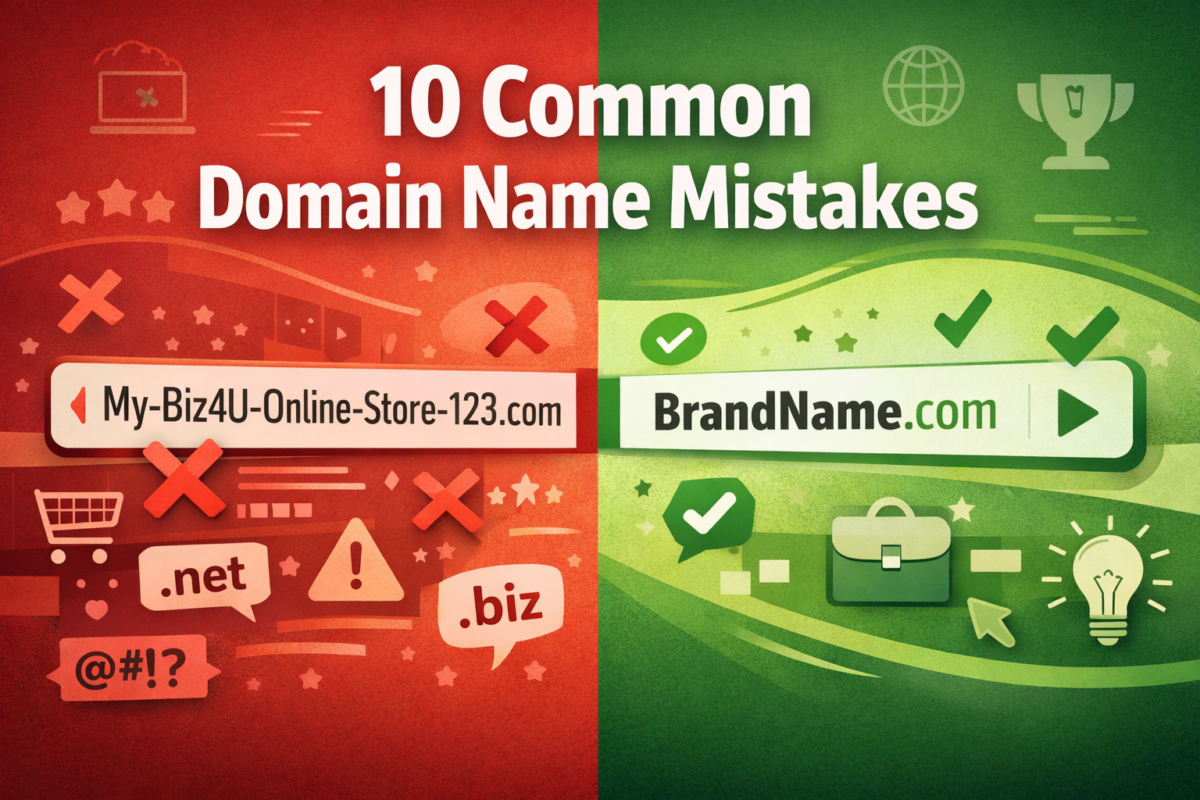
10 Common Domain Name Selection Mistakes

A lot of us treat a domain name like a technical requirement. Buy one, connect it to hosting, move on. That mindset creates problems early.

A domain name is not just the place where your website lives. It becomes part of how people remember you, search for you, talk about you, and trust you. In many cases, it is the first brand signal someone sees before they ever read your homepage.

That is why weak domain decisions tend to linger. A confusing or limiting name can affect word-of-mouth, branding, email credibility, click-through behavior, and even how easy it is to scale later.

This article breaks down ten of the most common domain name selection mistakes beginners make, especially those who underestimate its role as online brand representation. You will also learn how to think more strategically before registering a name.

Why a Domain Name Matters More Than Beginners Think

Think of your domain name as your storefront sign on the internet.

A bad sign may still get people through the door once, but it makes the business harder to remember and recommend. A good sign does quiet work in the background. It helps people recall you later, type your address correctly, trust your emails, and associate your name with a clear identity.

A strong domain name usually supports four things:

  • Memorability — people can recall it without effort
  • Clarity — they can understand what it refers to
  • Credibility — it sounds legitimate and established
  • Flexibility — it still fits as the business grows

Beginners often focus on availability alone. The better question is this: Will this name still make sense after my site gains traction?

The 10 Mistakes

1. Choosing a Domain Name That Is Too Long

Long domain names are harder to remember, type, share, and repeat in conversation.

A beginner might choose something like bestaffordabledigitalmarketingservicesonline.com because it contains useful keywords. On paper, it feels descriptive. In reality, it feels heavy, awkward, and forgettable.

Shorter names work better because they reduce friction. People are more likely to type them correctly, mention them to others, and remember them after seeing them once.

That does not mean every good domain must be five letters long. It means it should be as short as possible without becoming vague or strange.

Better approach:
Aim for a name that is concise, pronounceable, and easy to recall after hearing it once.


2. Using Hard-to-Spell or Confusing Words

If someone hears your domain name in a podcast, video, meeting, or conversation, can they spell it correctly without asking twice?

That simple test eliminates many weak domain choices.

Beginners often choose names with:

  • uncommon spellings
  • made-up words that sound unclear
  • double letters
  • silent-letter words
  • words commonly confused with other words

For example, a domain that sounds clever to you may create repeated friction for everyone else. If people need clarification every time, the name is doing the opposite of what a brand should do.

Good domain names reduce explanation.

Better approach:
Use familiar words, clean pronunciation, and simple spelling. If you say it aloud once and someone can type it correctly, that is a strong sign.


3. Prioritizing Keywords Over Brand Identity

Some beginners still think the best domain is one that exactly matches a search phrase.

That is why they end up with names like cheapcarinsurancequotes247.com or bestfitnesstipsblog.net. These may look SEO-friendly, but they often feel generic, low-trust, and hard to build into a brand.

Keywords can help with clarity, but they should not dominate the name. A domain is not just for search engines. It is for humans first.

A strong domain should sound like something people can trust, remember, and revisit. Exact-match domains no longer carry the kind of magic many beginners assume. Brand strength matters more over time.

Better approach:
Choose a domain that may include a relevant concept or keyword, but still feels like a real brand name rather than a search phrase.


4. Ignoring the Domain Extension

Some people focus only on the name before the dot and treat the extension as unimportant.

It is not unimportant.

Your extension affects perception. In many markets, .com still feels the most familiar and credible. Other extensions can work well too, especially when they align with geography, industry, or modern brand positioning. But beginners often select unusual extensions simply because the preferred name is unavailable.

That can create a problem. If your brand is BrightPath on a rare extension, many people may still assume you are BrightPath.com. That means lost traffic, confusion, and possible credibility issues.

Better approach:
Use an extension that fits your audience and business type. If your audience expects .com, do not dismiss that expectation too quickly. Familiarity matters.


5. Not Checking Trademarks or Brand Conflicts

This mistake feels small at the start and expensive later.

A domain may be technically available but still create legal or branding conflict if it closely resembles an existing company, product, or trademark. Beginners sometimes assume domain availability equals safe usage. It does not.

Even if legal trouble never appears, brand confusion alone is enough reason to be careful. If your name sounds like another established company, you risk being mistaken for them or permanently compared to them.

That is a poor foundation for a new brand.

Better approach:
Before registering a domain, check for trademark conflicts, search existing businesses, and review whether the name is already associated with another brand in your niche.


6. Choosing a Name That Limits Future Growth

This is one of the most common strategic mistakes.

A beginner starts a site about one narrow idea and picks a domain tied tightly to that exact niche. Later, the business expands, but the name does not.

Imagine starting with OnlyYogaMatsOnline.com and later wanting to sell broader fitness products. Or using a city-specific name when the business later serves national or global customers.

A narrow name may feel smart in the beginning because it creates focus. But a domain should support your next stage too, not just your first month.

Better approach:
Choose a name wide enough to grow with your business, but not so broad that it becomes meaningless.


7. Using Numbers, Hyphens, or Extra Characters

These choices usually create friction, not distinction.

Numbers raise questions: is it a numeral or a spelled-out word?
Hyphens create errors: did the domain include one hyphen, two, or none?
Extra characters often make the domain look less polished.

A beginner may register a name with hyphens because the cleaner version is unavailable. That solves the registration problem, but it often creates a branding problem.

When people hear your domain, they should not need formatting instructions.

Better approach:
Avoid hyphens and numbers unless there is an exceptionally strong reason. Clean domains are easier to remember and communicate.


8. Failing to Check Social Media Handle Availability

A domain name does not exist in isolation anymore.

If your website name and your social handles are completely different, brand consistency becomes harder. People may struggle to find you, recognize you, or trust that your profiles are official.

Beginners often choose a domain first and only later realize that every matching username is unavailable. The result is a scattered brand identity across platforms.

That does not mean every handle must be perfectly identical, but consistency helps more than most people think.

Better approach:
Before committing, check whether similar usernames are available across the platforms relevant to your audience.


9. Picking a Trendy Name That Ages Quickly

Trend-based names can feel modern at first and outdated surprisingly fast.

This happens when people choose slang, hype words, or naming styles built around what sounds current rather than what sounds durable. A name that feels “internet clever” today may feel dated in two years.

Brand names generally age better when they are simple, clear, and not overly tied to a passing trend.

A domain should survive changes in platform culture, design style, and audience behavior.

Better approach:
Choose a name with a longer shelf life. Ask yourself whether it will still sound credible five years from now.


10. Registering the First “Available” Name Without Testing It

Availability is not validation.

Some beginners spend hours searching, finally find an open domain, and register it immediately out of relief. That impulse is understandable, but risky.

A better process is to pressure-test the name first:

  • Say it out loud
  • Share it with someone else
  • Ask them what they think it means
  • Ask them to spell it from memory
  • Imagine it on a logo, email address, and social profile
  • Consider whether it still works if the business grows

A domain might be available because nobody wanted it, not because you found hidden gold.

Better approach:
Test the name before registering. A few minutes of evaluation can prevent a long-term branding mistake.

Practical Tips for Choosing a Better Domain Name

Here is a more useful way to think about domain selection:

Start with brand clarity

What do you want people to feel or understand when they see the name? Professional? Friendly? Modern? Niche-specific? Established?

Make it easy to say and easy to remember

If people cannot repeat it, they are less likely to return to it.

Think beyond launch day

Your domain should support future content, products, services, or positioning.

Check for friction points

Look for spelling issues, confusing pronunciation, legal conflicts, and social handle mismatch.

Favor trust over cleverness

Clever names can be fun, but trust and clarity usually win in the long run.

Common Misconceptions About Domain Names

“It is just a URL.”

Not really. It becomes part of your identity, your emails, your marketing, and your brand recall.

“More keywords means better SEO.”

Not necessarily. Over-optimized domains often look spammy or generic. Branding matters.

“I can always change it later.”

You can, but it is rarely painless. Domain changes can affect branding consistency, backlinks, redirects, email addresses, and audience familiarity.

“Any extension is fine.”

Sometimes yes, but audience expectations matter. Trust is partly shaped by what feels familiar.

FAQ

1. Why is domain name selection so important for beginners?

Because it shapes first impressions, memorability, credibility, and long-term brand flexibility. A domain is not just technical infrastructure; it is part of your public identity.

2. Should I always choose a .com domain?

Not always, but .com is still the most familiar choice for many audiences. If your market expects it and it is available, it is often a strong option.

3. Are keywords in domain names still useful?

They can help with clarity, but they should not come at the cost of branding. A domain stuffed with keywords often feels generic and less trustworthy.

4. Is it okay to use hyphens or numbers in a domain?

Usually no. They create confusion, increase typing errors, and make the name harder to communicate verbally.

5. Can I rebrand my domain later if needed?

Yes, but it can be disruptive. Rebranding later may affect SEO, email addresses, backlinks, and brand recognition, so it is better to choose carefully at the beginning.

Conclusion

The biggest mistake beginners make is thinking a domain name is only an address.

It is closer to a digital brand anchor. It influences how people remember you, trust you, search for you, and talk about you. That is why domain selection deserves more thought than many new site owners give it.

The best domain names are rarely the most complicated or the most keyword-heavy. They are usually the ones that feel clear, credible, easy to remember, and flexible enough to grow.

A good test is simple: if someone hears the name once, can they understand it, spell it, remember it, and trust it? If the answer is yes, you are probably moving in the right direction.

Well, if you still have any doubts, I would be more than happy to connect.

I have written two more interesting articles, which you should consider reading.

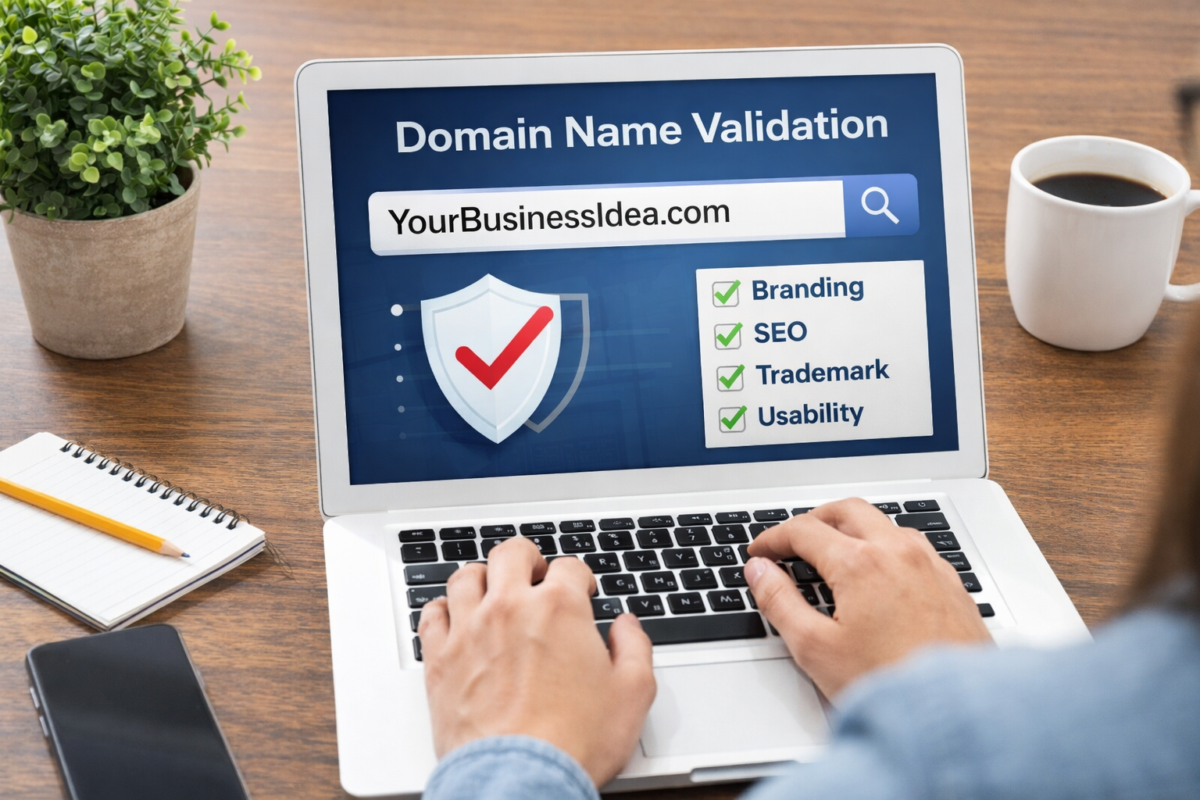
How to Validate Your Domain Name for Your Business Idea

Choosing a domain name for your business idea can feel deceptively simple. You think of a name, check whether it is available, and buy it. Done.

In reality, a domain name does much more than give your business a web address. It shapes first impressions, affects memorability, influences trust, and can either support or weaken your branding over time. A name that looks clever in your head may confuse customers, overlap with another brand, or box you into a niche you outgrow six months later.

That is why validation matters.

Validating a domain name idea means testing whether it is actually a good fit for your business before you commit to it. You are not just asking, “Is this available?” You are asking better questions: “Will people remember it? Can they spell it? Does it sound credible? Is it legally risky? Will it still make sense as the business grows?”

This guide walks through a practical way to validate your domain name idea before you launch your business website.

Why Domain Name Validation Matters

A strong domain name works quietly in the background. It helps people find you, trust you, and remember you. A weak one creates small points of friction everywhere.

Think of it like naming a shop on a busy street. If the sign is clear, simple, and easy to remember, people can return later and tell others about it. If the sign is hard to read or easy to confuse with another store, you lose attention before the relationship even starts.

A validated domain name should ideally do four things well:

  • Match your brand or business direction
  • Be easy to understand, spell, and say
  • Avoid legal or brand confusion
  • Still feel relevant a year or two from now

This is especially important for small businesses. You may only get one clean chance to establish your online identity. Changing domains later is possible, but it often means rebranding, redirecting pages, updating listings, and rebuilding trust signals.

Step 1: Start With Your Business Positioning

Before you validate the domain name, validate the idea behind the name.

Ask yourself what your business actually needs the domain to communicate. Is your brand supposed to feel premium, local, modern, playful, traditional, technical, or personal? A good domain name should support that impression, not fight it.

For example:

  • A law firm may need something clear, credible, and professional
  • A handmade candle brand might benefit from warmth and personality
  • A SaaS startup may prefer something short, modern, and scalable
  • A local bakery may want a name that connects with the location or specialty

This step is often skipped. People get attached to names that sound clever but do not fit the business model. A name might be catchy, but if it sends the wrong message, it creates friction from the beginning.

Write down three things your brand should communicate. Use those traits as a filter for every domain name idea you consider.

Step 2: Check for Clarity, Simplicity, and Memorability

A domain name should be easy for a real person to process quickly.

That means it should be:

  • Easy to pronounce
  • Easy to spell after hearing it once
  • Easy to remember later
  • Free from awkward hyphens or unnecessary numbers

A simple test helps here: say the name out loud to someone and ask them to type it without seeing it. If they misspell it, hesitate, or ask you to repeat it, the domain may already be too complicated.

Names fail this test more often than people expect. Words with unusual spellings, double letters, or blended terms can look creative on paper but become annoying in real life.

For instance, a domain like kwiklyhq.com may feel startup-friendly, but many users will pause. Is it “quickly”? Is it “kwikly”? Do they include “hq”? That tiny confusion adds up.

A name that is easy to remember often beats one that is overly clever.

Step 3: Make Sure It Fits Long-Term Growth

A domain name should not just fit your business today. It should still make sense if your business expands.

This is where many early-stage businesses trap themselves. They choose a highly specific name tied to one product, one city, or one narrow service, only to outgrow it fast.

For example:

  • bestcupcakesindelhi.com works poorly if you later sell cookies, cakes, or open in another city
  • mikeswebdesignservice.com may feel limiting if you expand into branding, SEO, or consulting

That does not mean every domain must be broad and abstract. It means you should think one or two stages ahead. Ask whether the name still works if your product line changes, your audience grows, or your positioning evolves.

A flexible domain gives you room to grow without forcing a rebrand too soon.

Step 4: Check Domain Availability Across Key Extensions

Once a name passes the branding test, check whether the domain is available.

In most cases, .com is still the strongest choice because it is familiar, trusted, and often the first extension people assume. If the .com version is available and affordable, it is usually worth serious consideration.

That said, many small businesses now use alternatives like .co, .io, .net, .store, or country-based extensions. These can work, but only if they make sense for your audience and do not create confusion.

When checking availability, think beyond one version:

  • Is the .com available?
  • Are the close variations already taken?
  • Are common misspellings owned by someone else?
  • Is the same name being used on major social platforms?

A domain can technically be available while still being a poor choice if a nearly identical brand already exists elsewhere online. That can lead to lost traffic, customer confusion, or reputation issues.

Step 5: Do a Basic Trademark and Brand Conflict Check

This is one of the most important validation steps.

Even if a domain is available, that does not mean you can safely use it. Another company may already operate under the same or a very similar name in your category or region.

At a minimum, do a basic screening:

  • Search the business name on Google
  • Check social media handles
  • Search your country’s trademark database
  • Look for businesses in the same industry using similar wording

You are looking for obvious red flags, not trying to perform a full legal review on your own. If you find similar names in the same market, treat that as a warning sign.

The risk is not only legal. It is practical too. If customers keep confusing you with another company, your branding becomes harder from day one.

A name that feels unique to you may already exist in someone else’s world.

Step 6: Evaluate Search and Brandability Together

People often assume a domain name must include exact keywords to perform well in search. That is outdated thinking.

A domain like bestaffordableplumbingservicesonline.com It is not automatically better for SEO than a cleaner brand name. Search engines look at the total quality and relevance of your site, not just your domain name wording.

Still, keywords can be helpful when used naturally.

For example:

  • GreenMandi.com feels like a brand
  • AppDeveloper.in clearly describes a local business
  • AndroidAppBuilder.com may work if it aligns with services and audience

The real goal is balance. You want a domain that is brandable and understandable. If it includes a useful keyword naturally, great. If forcing keywords makes it sound generic or awkward, it is usually not worth it.

A memorable brand often outperforms a keyword-stuffed name in the long run because people recall it, recommend it, and trust it more easily.

Step 7: Test It With Real People

This is the most underrated step in domain name validation.

Choose three to five domain ideas and show them to people who resemble your target audience. Ask simple questions:

  • Which one sounds most trustworthy?
  • Which one is easiest to remember?
  • Which one sounds like a real business?
  • Which one would you be most likely to click?

Do not over-explain your preferences before asking. Let people react naturally.

You may be surprised by the results. Founders often fall in love with names because of internal meaning, wordplay, or personal attachment. Customers do not share that context. They judge the name in seconds.

Good validation is not about defending your favorite option. It is about noticing how others actually perceive it.

Common Mistakes When Validating a Domain Name

Mistake 1: Buying a name just because it is available

Availability is only one filter. A bad name can still be available.

Mistake 2: Choosing something too trendy

Trendy names can age quickly. What sounds modern now may feel dated later.

Mistake 3: Ignoring pronunciation and spelling issues

If people cannot say it or type it correctly, the name creates unnecessary friction.

Mistake 4: Over-optimizing for keywords

A domain should help your brand, not read like a search query from 2012.

Mistake 5: Skipping conflict checks

Legal and brand confusion problems are much easier to avoid early than fix later.

Mistake 6: Thinking only about today

Your domain should support the business you are building, not just the version of it that exists this month.

A Simple Domain Validation Checklist

Before you buy a domain, make sure you can answer yes to most of these:

Branding

  • Does it match your business identity?
  • Does it sound credible to your audience?

Usability

  • Is it easy to spell, say, and remember?
  • Does it avoid hyphens, numbers, and awkward wording?

Growth

  • Will it still fit if the business expands?
  • Is it not overly tied to one small niche or location unless that is intentional?

Availability and Conflicts

  • Is the domain available in your preferred extension?
  • Are the social handles reasonably aligned?
  • Have you checked for obvious trademark or brand conflicts?

Market Feedback

  • Do other people respond well to it?
  • Does it pass the “say it once and remember it later” test?

If several answers are no, keep exploring.

Final Thoughts

A good domain name does not need to be perfect. It needs to be clear, usable, and aligned with your business.

That is the real purpose of validation. You are reducing regret before you invest time, money, and marketing energy into the wrong online identity.

The strongest domain names are rarely the most complicated. They are the ones that make sense quickly, feel trustworthy, and support the business as it grows.

When in doubt, choose clarity over cleverness, simplicity over novelty, and long-term fit over short-term excitement.

That decision usually ages well.

FAQ Section

1. How do I know if my domain name idea is good?

A good domain name is easy to remember, easy to spell, relevant to your business, and unlikely to be confused with another brand. It should also feel credible to your target audience.

2. Should my business domain name include keywords?

It can, but only if the keyword fits naturally. A forced keyword domain often sounds generic. Brandability and clarity usually matter more than squeezing in exact search terms.

3. Is .com always the best domain extension?

Not always, but it is often the safest and most familiar choice. If .com is unavailable, another extension can still work if it suits your audience and does not create confusion.

4. Can I use a domain name if it is available to register?

Not necessarily. Domain availability does not guarantee legal safety. You should still check for trademarks, existing businesses, and brand conflicts before using it.

5. What is the biggest mistake people make when choosing a domain name?

One of the biggest mistakes is choosing a name based only on availability or personal preference without testing how real customers will interpret, remember, and trust it.

If you want to learn more about domain names, then connect with me. I can help you choose the right domain name for your Business Idea, Personal Brand, Product Launch, etc.
If you like this post, then do read: How to Find the Perfect Domain Name for Your Venture in 2026