How to Validate Your Domain Name for Your Business Idea

Choosing a domain name for your business idea can feel deceptively simple. You think of a name, check whether it is available, and buy it. Done.
In reality, a domain name does much more than give your business a web address. It shapes first impressions, affects memorability, influences trust, and can either support or weaken your branding over time. A name that looks clever in your head may confuse customers, overlap with another brand, or box you into a niche you outgrow six months later.
That is why validation matters.
Validating a domain name idea means testing whether it is actually a good fit for your business before you commit to it. You are not just asking, “Is this available?” You are asking better questions: “Will people remember it? Can they spell it? Does it sound credible? Is it legally risky? Will it still make sense as the business grows?”
Table of Contents
This guide walks through a practical way to validate your domain name idea before you launch your business website.
Why Domain Name Validation Matters
A strong domain name works quietly in the background. It helps people find you, trust you, and remember you. A weak one creates small points of friction everywhere.
Think of it like naming a shop on a busy street. If the sign is clear, simple, and easy to remember, people can return later and tell others about it. If the sign is hard to read or easy to confuse with another store, you lose attention before the relationship even starts.
A validated domain name should ideally do four things well:
- Match your brand or business direction
- Be easy to understand, spell, and say
- Avoid legal or brand confusion
- Still feel relevant a year or two from now
This is especially important for small businesses. You may only get one clean chance to establish your online identity. Changing domains later is possible, but it often means rebranding, redirecting pages, updating listings, and rebuilding trust signals.
Step 1: Start With Your Business Positioning
Before you validate the domain name, validate the idea behind the name.
Ask yourself what your business actually needs the domain to communicate. Is your brand supposed to feel premium, local, modern, playful, traditional, technical, or personal? A good domain name should support that impression, not fight it.
For example:
- A law firm may need something clear, credible, and professional
- A handmade candle brand might benefit from warmth and personality
- A SaaS startup may prefer something short, modern, and scalable
- A local bakery may want a name that connects with the location or specialty
This step is often skipped. People get attached to names that sound clever but do not fit the business model. A name might be catchy, but if it sends the wrong message, it creates friction from the beginning.
Write down three things your brand should communicate. Use those traits as a filter for every domain name idea you consider.
Step 2: Check for Clarity, Simplicity, and Memorability
A domain name should be easy for a real person to process quickly.
That means it should be:
- Easy to pronounce
- Easy to spell after hearing it once
- Easy to remember later
- Free from awkward hyphens or unnecessary numbers
A simple test helps here: say the name out loud to someone and ask them to type it without seeing it. If they misspell it, hesitate, or ask you to repeat it, the domain may already be too complicated.
Names fail this test more often than people expect. Words with unusual spellings, double letters, or blended terms can look creative on paper but become annoying in real life.
For instance, a domain like kwiklyhq.com may feel startup-friendly, but many users will pause. Is it “quickly”? Is it “kwikly”? Do they include “hq”? That tiny confusion adds up.
A name that is easy to remember often beats one that is overly clever.
Step 3: Make Sure It Fits Long-Term Growth
A domain name should not just fit your business today. It should still make sense if your business expands.
This is where many early-stage businesses trap themselves. They choose a highly specific name tied to one product, one city, or one narrow service, only to outgrow it fast.
For example:
bestcupcakesindelhi.comworks poorly if you later sell cookies, cakes, or open in another citymikeswebdesignservice.commay feel limiting if you expand into branding, SEO, or consulting
That does not mean every domain must be broad and abstract. It means you should think one or two stages ahead. Ask whether the name still works if your product line changes, your audience grows, or your positioning evolves.
A flexible domain gives you room to grow without forcing a rebrand too soon.
Step 4: Check Domain Availability Across Key Extensions
Once a name passes the branding test, check whether the domain is available.
In most cases, .com is still the strongest choice because it is familiar, trusted, and often the first extension people assume. If the .com version is available and affordable, it is usually worth serious consideration.
That said, many small businesses now use alternatives like .co, .io, .net, .store, or country-based extensions. These can work, but only if they make sense for your audience and do not create confusion.
When checking availability, think beyond one version:
- Is the
.comavailable? - Are the close variations already taken?
- Are common misspellings owned by someone else?
- Is the same name being used on major social platforms?
A domain can technically be available while still being a poor choice if a nearly identical brand already exists elsewhere online. That can lead to lost traffic, customer confusion, or reputation issues.
Step 5: Do a Basic Trademark and Brand Conflict Check
This is one of the most important validation steps.
Even if a domain is available, that does not mean you can safely use it. Another company may already operate under the same or a very similar name in your category or region.
At a minimum, do a basic screening:
- Search the business name on Google
- Check social media handles
- Search your country’s trademark database
- Look for businesses in the same industry using similar wording
You are looking for obvious red flags, not trying to perform a full legal review on your own. If you find similar names in the same market, treat that as a warning sign.
The risk is not only legal. It is practical too. If customers keep confusing you with another company, your branding becomes harder from day one.
A name that feels unique to you may already exist in someone else’s world.
Step 6: Evaluate Search and Brandability Together
People often assume a domain name must include exact keywords to perform well in search. That is outdated thinking.
A domain like bestaffordableplumbingservicesonline.com It is not automatically better for SEO than a cleaner brand name. Search engines look at the total quality and relevance of your site, not just your domain name wording.
Still, keywords can be helpful when used naturally.
For example:
GreenMandi.comfeels like a brandAppDeveloper.inclearly describes a local businessAndroidAppBuilder.commay work if it aligns with services and audience
The real goal is balance. You want a domain that is brandable and understandable. If it includes a useful keyword naturally, great. If forcing keywords makes it sound generic or awkward, it is usually not worth it.
A memorable brand often outperforms a keyword-stuffed name in the long run because people recall it, recommend it, and trust it more easily.
Step 7: Test It With Real People
This is the most underrated step in domain name validation.
Choose three to five domain ideas and show them to people who resemble your target audience. Ask simple questions:
- Which one sounds most trustworthy?
- Which one is easiest to remember?
- Which one sounds like a real business?
- Which one would you be most likely to click?
Do not over-explain your preferences before asking. Let people react naturally.
You may be surprised by the results. Founders often fall in love with names because of internal meaning, wordplay, or personal attachment. Customers do not share that context. They judge the name in seconds.
Good validation is not about defending your favorite option. It is about noticing how others actually perceive it.
Common Mistakes When Validating a Domain Name
Mistake 1: Buying a name just because it is available
Availability is only one filter. A bad name can still be available.
Mistake 2: Choosing something too trendy
Trendy names can age quickly. What sounds modern now may feel dated later.
Mistake 3: Ignoring pronunciation and spelling issues
If people cannot say it or type it correctly, the name creates unnecessary friction.
Mistake 4: Over-optimizing for keywords
A domain should help your brand, not read like a search query from 2012.
Mistake 5: Skipping conflict checks
Legal and brand confusion problems are much easier to avoid early than fix later.
Mistake 6: Thinking only about today
Your domain should support the business you are building, not just the version of it that exists this month.
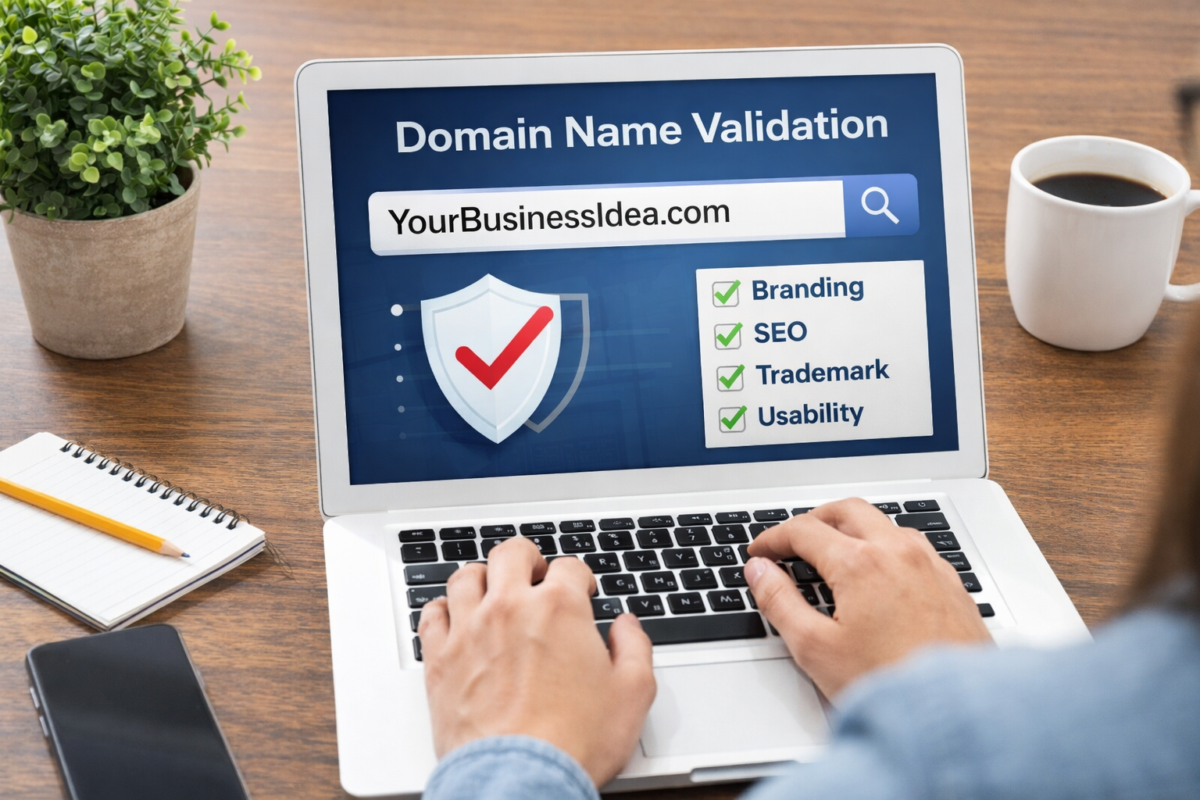
A Simple Domain Validation Checklist
Before you buy a domain, make sure you can answer yes to most of these:
Branding
- Does it match your business identity?
- Does it sound credible to your audience?
Usability
- Is it easy to spell, say, and remember?
- Does it avoid hyphens, numbers, and awkward wording?
Growth
- Will it still fit if the business expands?
- Is it not overly tied to one small niche or location unless that is intentional?
Availability and Conflicts
- Is the domain available in your preferred extension?
- Are the social handles reasonably aligned?
- Have you checked for obvious trademark or brand conflicts?
Market Feedback
- Do other people respond well to it?
- Does it pass the “say it once and remember it later” test?
If several answers are no, keep exploring.
Final Thoughts
A good domain name does not need to be perfect. It needs to be clear, usable, and aligned with your business.
That is the real purpose of validation. You are reducing regret before you invest time, money, and marketing energy into the wrong online identity.
The strongest domain names are rarely the most complicated. They are the ones that make sense quickly, feel trustworthy, and support the business as it grows.
When in doubt, choose clarity over cleverness, simplicity over novelty, and long-term fit over short-term excitement.
That decision usually ages well.
FAQ Section
1. How do I know if my domain name idea is good?
A good domain name is easy to remember, easy to spell, relevant to your business, and unlikely to be confused with another brand. It should also feel credible to your target audience.
2. Should my business domain name include keywords?
It can, but only if the keyword fits naturally. A forced keyword domain often sounds generic. Brandability and clarity usually matter more than squeezing in exact search terms.
3. Is .com always the best domain extension?
Not always, but it is often the safest and most familiar choice. If .com is unavailable, another extension can still work if it suits your audience and does not create confusion.
4. Can I use a domain name if it is available to register?
Not necessarily. Domain availability does not guarantee legal safety. You should still check for trademarks, existing businesses, and brand conflicts before using it.
5. What is the biggest mistake people make when choosing a domain name?
One of the biggest mistakes is choosing a name based only on availability or personal preference without testing how real customers will interpret, remember, and trust it.
If you want to learn more about domain names, then connect with me. I can help you choose the right domain name for your Business Idea, Personal Brand, Product Launch, etc.
If you like this post, then do read: How to Find the Perfect Domain Name for Your Venture in 2026