Recently, while reviewing a small group of domain names related to NLP, I realized something interesting.
When I look at domain names, I try not to ask only one question: “How much can I sell this for?”
I ask another question that often leads to better ideas: “What could someone actually build on this?”
Although these names belong to the same niche, each one naturally points toward a different business model, audience, and brand identity.
For this article, I’m using NLP primarily in the context of Neuro-Linguistic Programming – training, personal development, coaching, communication, mindset, and behavioral learning.
NOTE: Though a few of these domain names could potentially be adapted later for AI or Natural Language Processing use cases.
Neuro-Linguistic Programming (NLP) is a psychological and communication framework that explores how our brains process language, our physical and neurological responses, and the behavioral patterns we develop over time. It offers tools to help individuals reprogram their thoughts and behaviors to achieve specific personal and professional goals.
The Three Pillars of NLP: NLP is built on three core components
- Neuro (Neurology): How our brains process the information, sights, sounds, and feelings we experience.
- Linguistic (Language): How we use verbal and non-verbal language to communicate, organize our thoughts, and make meaning of the world.
- Programming (Behavior): How we organize our thoughts and actions to achieve specific goals. [1]
Key Techniques
Practitioners use various NLP techniques to help clients shift their mindsets. Common tools include:
- Modeling: Studying and adopting the habits and communication styles of successful people to reproduce similar results.
- Reframing: Learning to view past experiences or negative thoughts from a different, more empowering perspective.
- Anchoring: Using specific triggers (like a touch, sound, or word) to quickly access positive or confident emotional states.
- Rapport: Building deep trust and harmony with others by matching and mirroring their body language and speech patterns. [2]
Applications and Criticisms
Developed in the 1970s by Richard Bandler and John Grinder, NLP is heavily used in life coaching, personal development, sales, and management. Many use it to reduce stress, build confidence, and improve overall communication. [3]
However, it is worth noting that NLP is considered pseudoscientific. While practitioners advocate for its benefits, it lacks a standard shared definition, and most of its techniques lack rigorous, empirical scientific validation.
If you are considering using NLP for personal growth or professional development, I can:
- Provide a deeper dive into specific NLP techniques
- Recommend books or beginner courses
- Discuss how it differs from traditional, evidence-based therapy
Let me know what you’d like to explore further.
AI responses may include mistakes.
[1] https://www.georginasaycetherapies.co.uk/neuro-linguistic-programming-nlp/
[2] https://stresssolutionsny.com/neuro-linguistic-programming-who-can-benefit/
[3] https://www.erickson.co.in/glossary/neuro-linguistic-programming-nlp/
Natural Language Processing (NLP) is a branch of artificial intelligence (AI) that gives machines the ability to read, understand, and generate human language. It acts as the bridge between human communication and computer understanding, powering everything from basic spell-checkers to advanced AI conversational agents.
Core Components
NLP combines computational linguistics with machine learning and deep learning models to process language in two main ways:
- NLU (Natural Language Understanding): Allows machines to comprehend the meaning, intent, and context behind human text or speech.
- NLG (Natural Language Generation): Enables computers to create their own human-sounding text or voice responses.
How It Works
Before a machine can understand language, it must process human words into numerical data. This involves breaking down text, removing unnecessary punctuation, analyzing grammar, and converting words into mathematical representations. Modern Large Language Models (LLMs) use advanced neural networks to recognize complex language patterns.
Everyday Applications
You likely interact with NLP multiple times a day. Common examples include:
- Digital Assistants: Voice-operated tools like Siri, Google Assistant, or Alexa.
- Generative AI & Chatbots: Conversational agents like ChatGPT.
- Translation: Real-time text or speech conversion from one language to another.
- Sentiment Analysis: Tools that analyze social media posts or reviews to determine if the writer is happy, angry, or neutral.
- Productivity Tools: Spell-checkers, auto-correct, and email auto-completes.
For deeper dives into technical architectures, you can explore the IBM NLP Guide or the AWS NLP Overview.
If you are interested in a specific area, I can:
- Detail how NLP handles languages in India
- Explain the difference between traditional NLP and Large Language Models (LLMs)
- Recommend beginner resources to start building your own NLP projects [3, 4, 5]
Let me know how you’d like to proceed!
AI responses may include mistakes.
[1] https://cloud.google.com/learn/what-is-natural-language-processing
[2] https://www.coursera.org/articles/natural-language-processing
[3] https://www.ibm.com/think/topics/natural-language-processing
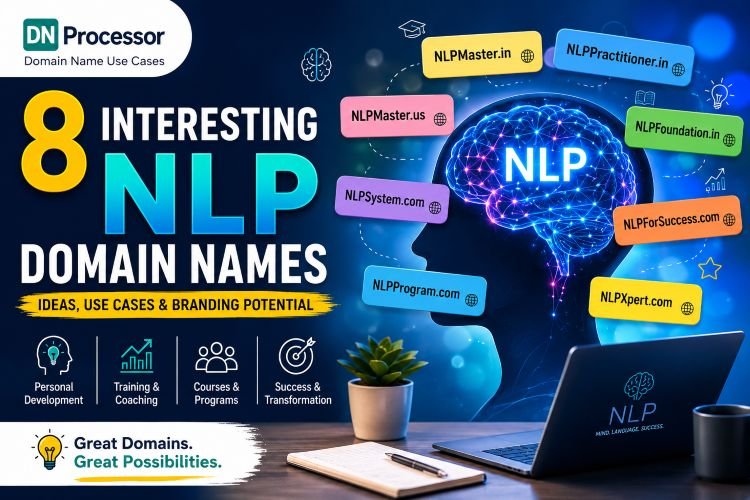
Instead of treating these as domains sitting in a portfolio, I wanted to evaluate them as if I were building real businesses behind them. Here’s how I see them.
First, What Makes a Domain Name Valuable?
Before looking at individual names, I usually evaluate domains using five filters:
- Can someone remember it after hearing it once?
- Does it suggest an outcome or transformation?
- Can it become a course, service, or membership site?
- Is it broad enough to grow?
- Does it sound credible?
It’s an interesting niche because people don’t just buy information. They often buy Programs, Certifications, Coaching, Community, Transformation. That changes how I think about domain quality.
Quick Comparison of the Portfolio
| Domain | Best Fit | Brand Strength | Development Potential |
|---|---|---|---|
| NLPMaster.in | Training Brand | ★★★★★ | ★★★★★ |
| NLPPractitioner.in | Certification Platform | ★★★★★ | ★★★★★ |
| NLPMaster.us | International Coaching | ★★★★☆ | ★★★★☆ |
| NLPFoundation.in | Beginner Education | ★★★★★ | ★★★★★ |
| NLPSystem.com | Framework / Method | ★★★★★ | ★★★★★ |
| NLPForSuccess.com | Self-Help Content | ★★★★☆ | ★★★★☆ |
| NLPProgram.com | Course Platform | ★★★★☆ | ★★★★☆ |
| NLPXpert.com | Personal Brand | ★★★☆☆ | ★★★☆☆ |
1. NLPMaster.in
This was one of the first names that stood out to me. The word “Master” immediately creates a progression model.
Beginner → Practitioner → Master.
That makes this domain feel naturally suited for education.
Business ideas:
- Training Institute
- Certification Pathway
- Membership Learning Portal
- Live Workshops
- Recorded Course Marketplace
Monetization: Course Sales, Certification Fees, Private Coaching, Corporate Training.
If I were developing this myself, I’d probably position it as: Become confident in communication, mindset, and influence through structured learning.
2. NLPPractitioner.in
This one feels commercially strong. People actively identify themselves as practitioners. That means this domain could attract both learners and certified professionals.
Website Concepts: Practitioner Directory, Certification Website, Training Center, Community Portal
Long-term Angle: Create trainer profiles, reviews, and practitioner verification. This one feels more “professional services” than “content business.”
3. NLPMaster.us
Country extensions sometimes narrow the audience in a useful way. This one immediately feels international. I wouldn’t build a large content site here.
I’d build: Premium coaching, Group workshops, Executive communication training, Personal branding
A clean one-page funnel could be enough.
4. NLPFoundation.in
This may actually be my favorite in the portfolio. The word “Foundation” lowers resistance. Someone who feels intimidated by certifications may still start here.
Ideal positioning: Learn fundamentals before advanced programs.
Content ideas: What is NLP? Beginner exercises, Learning roadmap, Mini certifications, Community challenges. This domain feels educational and scalable.
5. NLPSystem.com
If I had to choose one domain to build into a larger company, this might be it.
The word “System” suggests: Framework, Methodology, Repeatability, Software, Process.
That creates flexibility. Possible directions:
- Education: Teach an NLP Methodology.
- SaaS: Build a learning or coaching system.
- Enterprise: Communication and behavioral workshops.
This one has the broadest expansion potential.
6. NLPForSuccess.com
Longer domain. But clear. This one feels outcome-driven.
Not everyone wants to learn NLP. Many people want: Better confidence, Better communication, Better habits. That changes positioning.
Content opportunities: Blog, Podcast, Newsletter, Affiliate recommendations, Digital products. This domain works well for media.
7. NLPProgram.com
Simple. Direct. Practical.
This domain feels like the natural home for structured learning.
Possible products: 30-day challenge, recorded curriculum, Trainer marketplace, Coaching bundles. This is one of those names where execution matters more than the domain itself.
8. NLPXpert.com
I usually become more selective with intentionally modified spellings. That said, “Xpert” still has branding potential. I would not build a large educational portal.
Instead: Personal coaching, Individual trainer brand, YouTube presence, and Consulting.
Keep the identity personality-driven.
If I Had to Build Only Three
After reviewing the portfolio, these would be my first picks:
- NLPSystem.com (Most expandable.)
- NLPFoundation.in (Strong educational positioning.)
- NLPPractitioner.in (Commercial and professional.)
My Take as a Domain Investor
One thing I’ve learned is that a good domain rarely arrives with a business attached. Sometimes the business becomes obvious only after spending time imagining who would actually visit the website.
This exercise reminded me that domain investing becomes more interesting when we stop asking:
“What can I sell?” …and start asking “What could someone build?”
Among these eight names, I can already see course businesses, certification programs, communities, coaching services, and content platforms.
Whether any of these become active projects or remain portfolio assets, I think that imagination process itself is worth documenting. And that’s exactly why I enjoy writing Domain Name Use Case articles.
If you wish to reach my team or me to discuss these domain names further, you are most welcome.